
On 1 August 2025, screenwriters logged in to Coverfly and found it gone. Years of submission history, contest placements, and the Coverfly Score that for many writers had become a proxy CV. All of it redirecting to FilmFreeway with no real explanation. If you were one of those writers, you know the particular feeling of watching part of your career history get archived without your input.
The bigger story isn't that Coverfly closed. It's why it closed, and what it means for everyone who relied on it.
What happened to Coverfly: the corporate timeline
The version of this story you've probably read goes: Coverfly shut down because of AI, or because of mismanagement, or because nobody wanted to pay for coverage anymore. The actual story is duller and more telling. Coverfly's closure was the final move in a multi-year consolidation that most writers never saw coming.
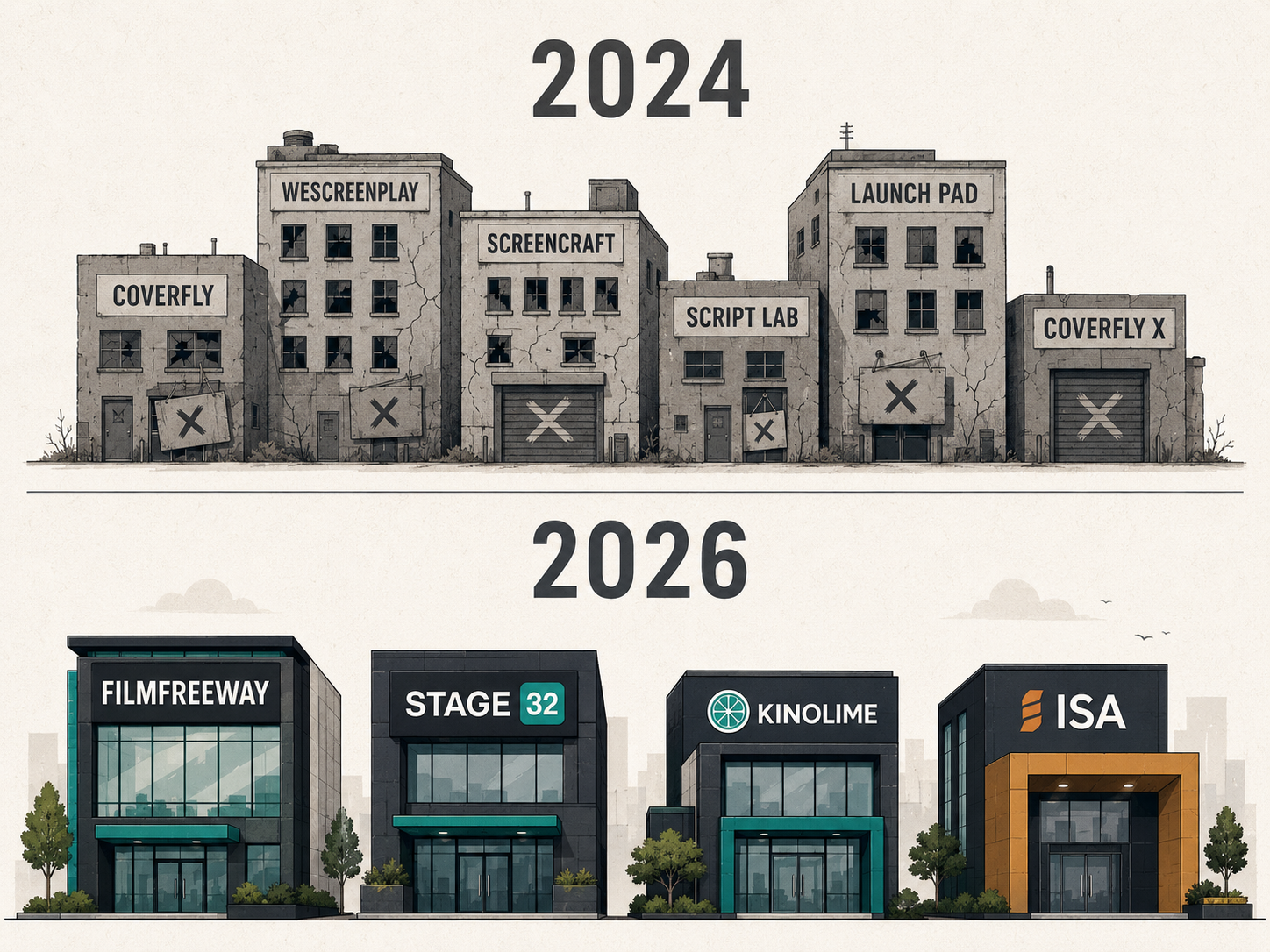
The ownership chain matters here. Coverfly was originally owned by Industry Arts, which also operated WeScreenplay, ScreenCraft, The Script Lab, and Launch Pad. In 2021, Backstage acquired Coverfly, FilmFreeway, and Voice123 in a $200 million spree. In February 2022, Cast & Crew, the production-services giant, acquired Backstage itself, gaining the entire portfolio in one transaction, alongside Industry Arts and the rest of its properties shortly after. Every overlapping product in that combined stable was now sitting on the same balance sheet.
By early 2025, the cuts had already started. WeScreenplay, ScreenCraft, The Script Lab, and Launch Pad all closed within a few months of each other. Quietly, mostly without much explanation, and with limited support for the writers who had paid for accounts on those platforms.
Coverfly X went first. The peer-to-peer feedback exchange shut down ahead of the main platform, which is the kind of detail you only notice if you were a regular user. Then on 1 August 2025, the main site followed. Traffic began redirecting to FilmFreeway, the only screenwriting submission product Cast & Crew chose to keep alive.
Tracking Board, the spec-script tracking site that had also belonged to Industry Arts, followed a month later on 1 September 2025.
This wasn't one platform dying. It was an entire ecosystem being pruned by a parent company that owned competing services and decided to keep just one.
What screenwriters lost when Coverfly closed
The Coverfly Score is what most writers mention first when they talk about what they lost. For thousands of writers, the composite metric aggregating their contest placements was the de facto CV. It was a single number that travelled with their submissions and signalled where they sat in the pile. Whether or not the score was a meaningful signal of talent, the industry recognised it, and now it's gone.
The Red List went with it. The public leaderboard had been one of the few free routes to industry visibility outside of paid promotion. If you finalled in enough contests, your name showed up where reps and producers looked. That ladder no longer exists.
Portfolio hosting and contest tracking disappeared in the same stroke, taking years of submission history, accolades, project pages, deadline tracking, and status updates with them. This had become operational infrastructure that writers built their workflow around.
Two more pieces went with the platform. CoverflyX, the token-based peer feedback exchange, had been a free way for writers to swap notes without paying for coverage. The Industry Dashboard, with its vetted access for around 2,000 reps, agents, and producers, had been Coverfly's most direct industry-facing product.
Some of this is recoverable. If you downloaded your data before the cutoff, you still have it. Specific contest results can sometimes be retrieved from the original contest organisers directly, and a handful of partner contests migrated to Stage 32's new hub. For most writers, though, the cutoff passed before they realised it was coming.
Why Coverfly shut down: the bigger pattern
Coverfly didn't close in a vacuum. Three forces converged in 12 months, and the platform sat at the intersection of all of them.
The first was corporate consolidation. Cast & Crew owned FilmFreeway and bought up the rest of the submission landscape, then trimmed what overlapped. Coverfly was the largest casualty, not a unique one.
The second was AI. Coverage that used to take a fortnight now takes minutes, and the economics of paying anywhere from $80 to $200 for a single human read started to collapse for a lot of writers.
The third came from the top of the ladder. The Academy's Nicholl Fellowship ended direct submissions in 2025; entries now run through Academy partner portals (for the 2026-27 cycle, the Black List and the Writers Guild Foundation). The most prestigious contest in the field tightened its gates at the same moment the lower tiers were being dismantled below it.
The result is a screenwriting career ladder with a layer cleanly removed in 12 months. Writers who built their progress on those platforms had the rug pulled. Writers entering now are looking at a fundamentally different landscape.
What replaced it
The pieces are largely in place, but they are spread across a dozen platforms rather than bundled into one account. Stage 32's Global Screenwriting Contest Hub came closest to a straight successor, hiring three former Coverfly employees including COO Mitch Lusas. FilmFreeway, owned by Cast & Crew, now carries most of the submission plumbing by default. Hosting, community and coverage fragmented across smaller players. We keep the full breakdown, sorted by which of the five jobs you actually need replaced, in 11 best Coverfly alternatives in 2026.
Not everything has a clean replacement. The aggregated Coverfly Score, with its single composite metric across every placement, doesn't currently exist anywhere. That gap is real, and it isn't being filled. What did get rebuilt is the discovery layer Coverfly was never especially good at: our free competitions directory checks every entry against the official source, including the free institutional routes like the BBC Writers Open Call and 4Screenwriting that a fee-driven hub had little reason to surface.
What Coverfly closing means for screenwriters
The closure forced three lessons that will outlast the platform itself.
Don't centralise your career on any one platform again. Use multiple submission services, keep your own records of placements and scores, and treat any free tool as potentially temporary. The infrastructure of a screenwriting career should be portable.
The score model is over.
A composite ranking from any single platform was always a proxy for the work, not the work itself. The shutdown made the underlying truth obvious: the script has to speak for itself, and you have to know whether it's working before anyone else weighs in. This is where AI-powered self-coverage becomes genuinely useful, not as another score to chase, but as a private feedback loop you control. That loop now extends to the rewrite itself: The PreList Editor keeps the notes beside the page while you redraft, so the read and the rewrite happen in one place.
And the shake-out cleared space. The platforms that emerge in 2026 can build better, learning from what failed. Writers entering the industry now don't have to unlearn assumptions that no longer hold.
The opportunity in the disruption
Some of what's emerging is genuinely better. The 2026 landscape is messier, but it's more accessible. AI tools have driven the cost of self-feedback close to zero, which puts serious analysis within reach of writers who could never afford repeat coverage.
UK and international writers have less reason to defer to US-centric infrastructure. Direct relationships with reps and producers are still possible, and the platforms that survive will probably matter more, not less, because writers will use them more deliberately.
What to do next
If Coverfly's closure has you rethinking where to submit, the next step is mapping the new landscape properly. The alternatives guide sorts the survivors by which Coverfly job each one replaces. The competitions directory carries verified deadlines, fees and an honest verdict for every listing. And the industry directory shows which agencies and production companies actually have an open door right now.
