Aaron Sorkin has a reputation, and you already know what it is. Long speeches. Walking and talking. Characters who are always the cleverest person in the room and never short of a word. It is the thing he gets praised for and the thing he gets parodied for, and it is the thing that every writer who has ever been told "this is a bit Sorkin-y" understands immediately.
We counted every speech in The Social Network. The reputation is wrong.
Not slightly wrong, or wrong in an interesting-caveat way. The median speech in The Social Network is six words long. Across forty produced screenplays we measured the same way, the median sits at seven. Sorkin's dialogue is, by this measure, marginally shorter than average.
Something in that script is obviously doing the thing everybody remembers. It just is not speech length.
Why this screenplay
The obvious reason is timing. The Social Reckoning, Sorkin's companion piece to The Social Network, arrives in cinemas on 9 October 2026, and a lot of writers are about to go back to the original to see how it was built.
The better reason is that The Social Network is one of the few screenplays with a genuinely widespread stylistic reputation. Most scripts are admired. This one is imitated, which means there is a received idea about how it works, and a received idea is a thing you can actually test.
Received ideas about craft are worth testing more often than they are. They tend to come from how a film feels in the room, and how a film feels is a product of the script, the performances, the edit and the score all at once. Peel the script off from the other three and the numbers are frequently not what the memory says.
What we measured, and what we did not
Every figure in this piece comes from parsing the publicly available shooting draft and counting. No model, no judgement, no scoring. A speech is one continuous block of dialogue under one character cue, counted once even where a page break splits it, and a character's voice-over and off-screen cues count as the same character. A scene is one slug line. Page positions are read from where the text actually prints, not estimated from word counts.
Two comparison sets run through this piece, and they are worth separating. The per-script figures, speeches per page and dialogue's share of the words, come from the 438 produced features in our research corpus, the same published dataset the benchmark pages use. The speech-length distribution comes from a smaller set of 40 produced screenplays spanning 1976 to 2025, because measuring every individual speech is not something the published corpus carries. Neither is a random sample of everything ever written. Both are samples of scripts that got made, which is the relevant benchmark if the question is how professional screenplays behave.
Two labels run through the rest of this piece, and it is worth being explicit about them:
- Measured means counted from the page. If it says 1,786 speeches, we counted 1,786 speeches.
- Interpreted means our reading of why the number looks like that. Those are arguments, and you are free to disagree with them.
Where a number is doing work in an argument, we have tried to make the seam visible.
The finding: the speeches are short
Here is the distribution. The Social Network against the corpus baseline, band by band.
Share of all speeches by length. The Social Network's mass sits further left than the typical produced screenplay: nearly a quarter of its speeches are one or two words.
Words per speech
Measured. 1,786 speeches across 164 pages of the publicly available shooting draft, parsed from the printed layout. Corpus figure is the median share per band across 40 produced screenplays (1976 to 2025). Percentages are of all speeches in each script.
Measured. 24.1% of the speeches in The Social Network are one or two words. The corpus median for that band is 15.3%. Half of all the speeches in the film come in at five words or fewer.
The longest single speech in the entire 164-page script is 98 words. That is around forty seconds of screen time, once. There is no monologue in The Social Network in the sense that a stage play has monologues, and there is no speech anywhere in it that would look out of place, on length alone, in an action film.
The one place Sorkin does sit above the corpus is at the far end: speeches over fifty words are 1.5% of his script against a corpus median of 0.7%. He writes roughly twice as many long speeches as a typical screenplay. They are still one line in every sixty-seven.
The long speeches are real. They are just rare enough to be punctuation, and everyone remembered the punctuation as the sentence.
Interpreted. That last figure is probably the whole explanation for the reputation. The arias exist, they are extraordinary, and they are the parts that get clipped and quoted and played at awards ceremonies. What gets forgotten is the ninety-eight per cent of the script that is people saying three words at each other.
Where the density actually comes from
If not length, then what? Turn-taking.
Speeches per page. This is how often the ball changes hands, independent of how long anyone talks for.
Measured. Speeches divided by printed page count, top 12 of the 438 produced features in our research corpus. The range runs from 1.1 (A Quiet Place) to 18.3 (Emma).
Measured. 10.9 speeches per page against a corpus median of 7.6, sixth of the 438 produced features we have measured. Roughly one and a half times the normal rate of exchange. Combined with the fact that dialogue is 57.6% of all the words in the script, against a corpus median of 36.7%, you get a page that is almost entirely people talking, in very short bursts, very fast.
That is the mechanism. A Sorkin page is dense because there are half again as many things happening on it as usual, and each one is small.
Interpreted. This is also why the imitations do not work. A writer who has decided to write something Sorkin-ish sits down and produces a four-hundred-word speech about the nature of loyalty, because that is what the memory says. The result is slow, because a long speech is structurally slow: it is one unit of information taking up a lot of room. Sorkin's pages move because they are made of many small units in rapid succession. Those are opposite techniques, and only one of them is on the page.
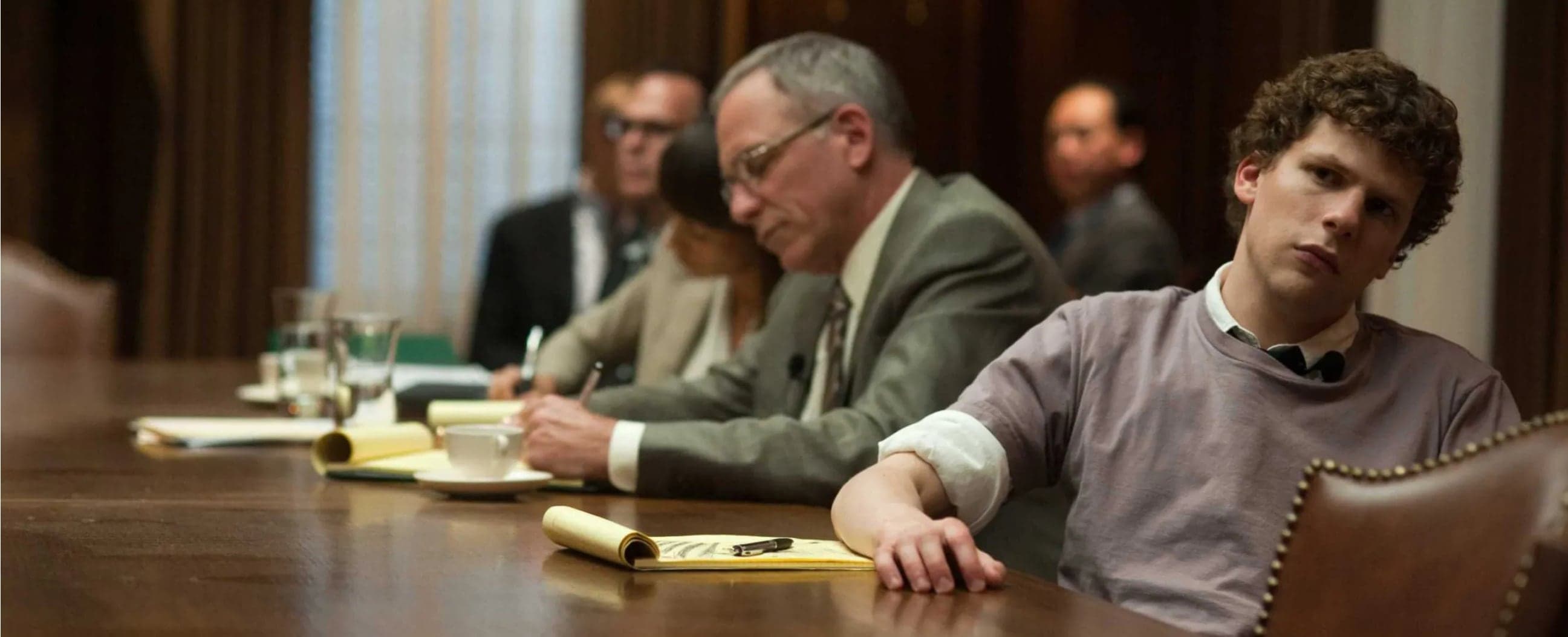
The opening scene is the demonstration piece. It is a couple sitting still at a table, and it plays like a chase. Nobody in it makes a speech.
Three more things the count turned up
Erica has 4.3% of the dialogue and appears in two scenes. She is fifth by word count out of 78 speaking characters, ahead of characters who are in the film throughout. Two scenes, both of them just two people at a table. Interpreted: the script's most quoted lines belong to a character with almost no screen time, which is a useful corrective to the idea that importance is measured in pages. The film's single most-remembered line is her last one.
A quarter of the script is people describing the film to lawyers. The two deposition rooms account for 50 of 189 scenes, 26% of the script, and 20% of all dialogue words. Interpreted: the frame is not a framing device in the light sense. It is a co-equal setting, and the film keeps cutting back to a room where the events we just watched are being contested. The structure is an argument about what happened, not a recollection of it.
The script is 86% interior. 163 scenes indoors against 26 outdoors. Interpreted: for a film remembered for walking and talking, there is remarkably little outdoors in it. The rooms are small, the settings repeat, and the movement is verbal.
What you can take from this
Three things, in descending order of how confident we are about them.
If you want a page to feel fast, cut the number of words per speech, not the number of speeches. This one is close to a direct read of the data. Density of exchange is the measurable difference between The Social Network and the corpus. Speech length is not.
Check your own median. Not your average, your median: averages get dragged around by a handful of long speeches and will tell you your dialogue is fine when half your script is a lecture. If your median speech is running to fifteen or twenty words, your characters are making statements at each other rather than talking, and that is usually a sign that they want the same thing, or that only one of them wants anything.
One-and-two-word speeches are a technique, not filler. Nearly a quarter of this script is at that length. Interruptions, corrections, one-word refusals and people saying each other's names are load-bearing: they are what makes an exchange feel like a contest. Writers cut them in revision because they look like nothing on the page. On screen they are most of the rhythm.
The one line worth quoting here is a Winklevoss twin's, and it is eight words: "I'm six-five, two-twenty, and there's two of me." That is the whole character, the whole joke and the whole threat, in one speech shorter than this sentence.
What this does not tell you
Quite a lot, and it is worth saying plainly.
Counting words cannot tell you whether dialogue is any good. It says nothing about wit, subtext, characterisation or whether a scene earns its ending. A script with an identical distribution to The Social Network could be unreadable. The numbers describe a shape, not a quality, and the shape is the least interesting thing about the screenplay.
Neither comparison set is a census. Both lean towards features that circulate as a PDF, which means the baseline is a baseline for that kind of film. A corpus of independent drama would sit somewhere else. The speech-length bands rest on the smaller 40-script set, so treat those as indicative rather than settled. The per-script figures come from the full 438, and the methodology and the data itself live in The Anatomy of a Produced Screenplay.
Corrected 9 September 2026. This piece first gave dialogue's share of the words as 66% against a median of 41%, and called the turn-taking rate the highest of the forty screenplays in the smaller set. Re-measured against the published 438-feature corpus, the share is 57.6% against a median of 36.7%, and five produced features change speaker more often. The finding itself is unchanged: the speeches are short, and the density comes from turn-taking.
We measured one draft. Scripts change between drafts, and the published shooting draft is not the thing Sorkin first handed in.
And the obvious one: dialogue on a page is not dialogue on screen. Rhythm gets made three more times after the script is finished, in casting, in performance and in the edit. Fincher famously shot a great many takes. What we have measured is the blueprint, and the blueprint is only ever part of the answer.
The series
This is the first in a run of breakdowns that measure produced screenplays rather than admiring them. The rule for each one is that the finding has to be something we did not already believe before we counted, which is why this piece exists: we expected to find long speeches.
If you want the same counting done on your own pages, that is what The PreList is for. And if you have just had notes back and are working out what to change first, the rewrite order framework is the companion piece to this one.