
Market Intelligence · Source-based briefing
The UK feature-film production picture
Edition 1.0.1 · Published · Correction note
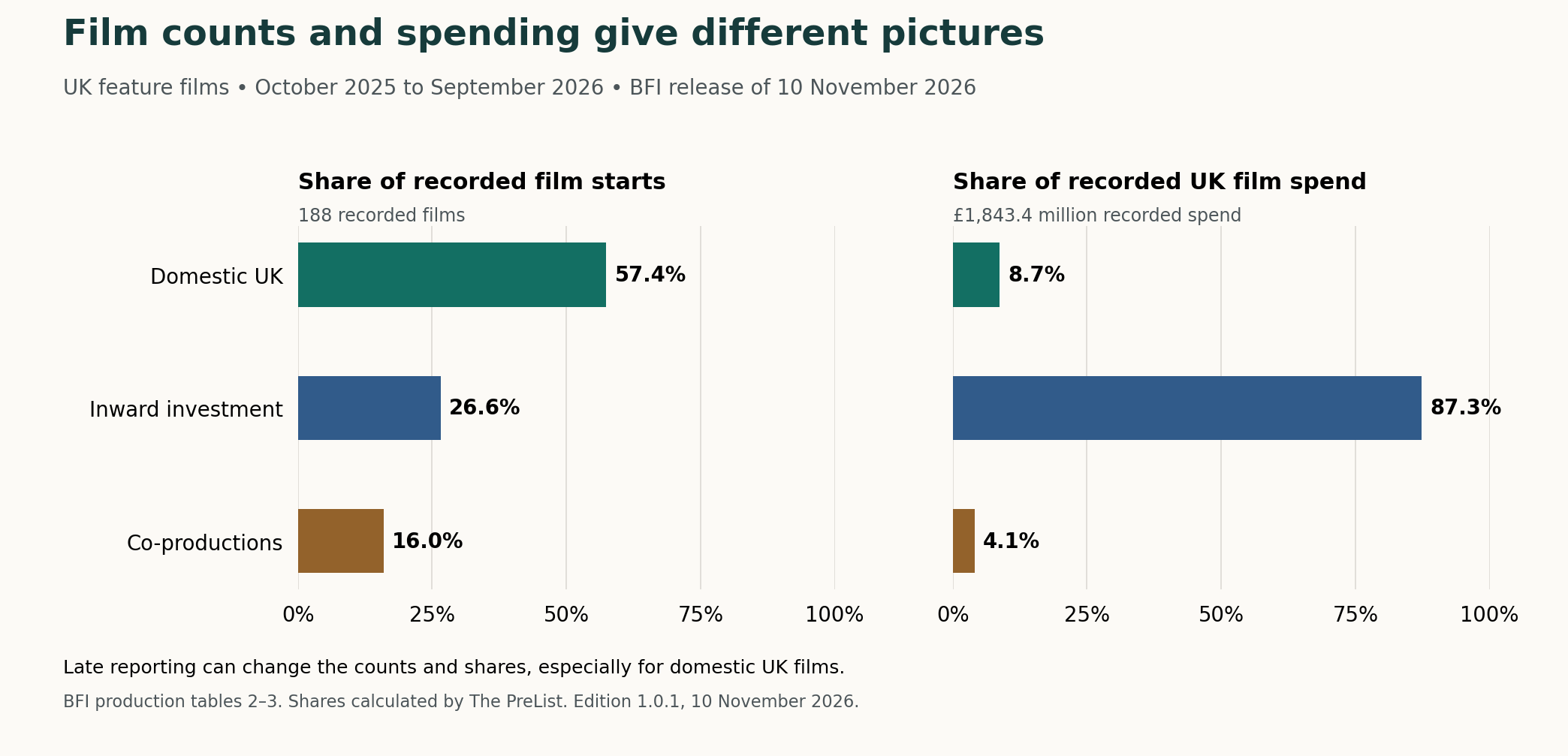
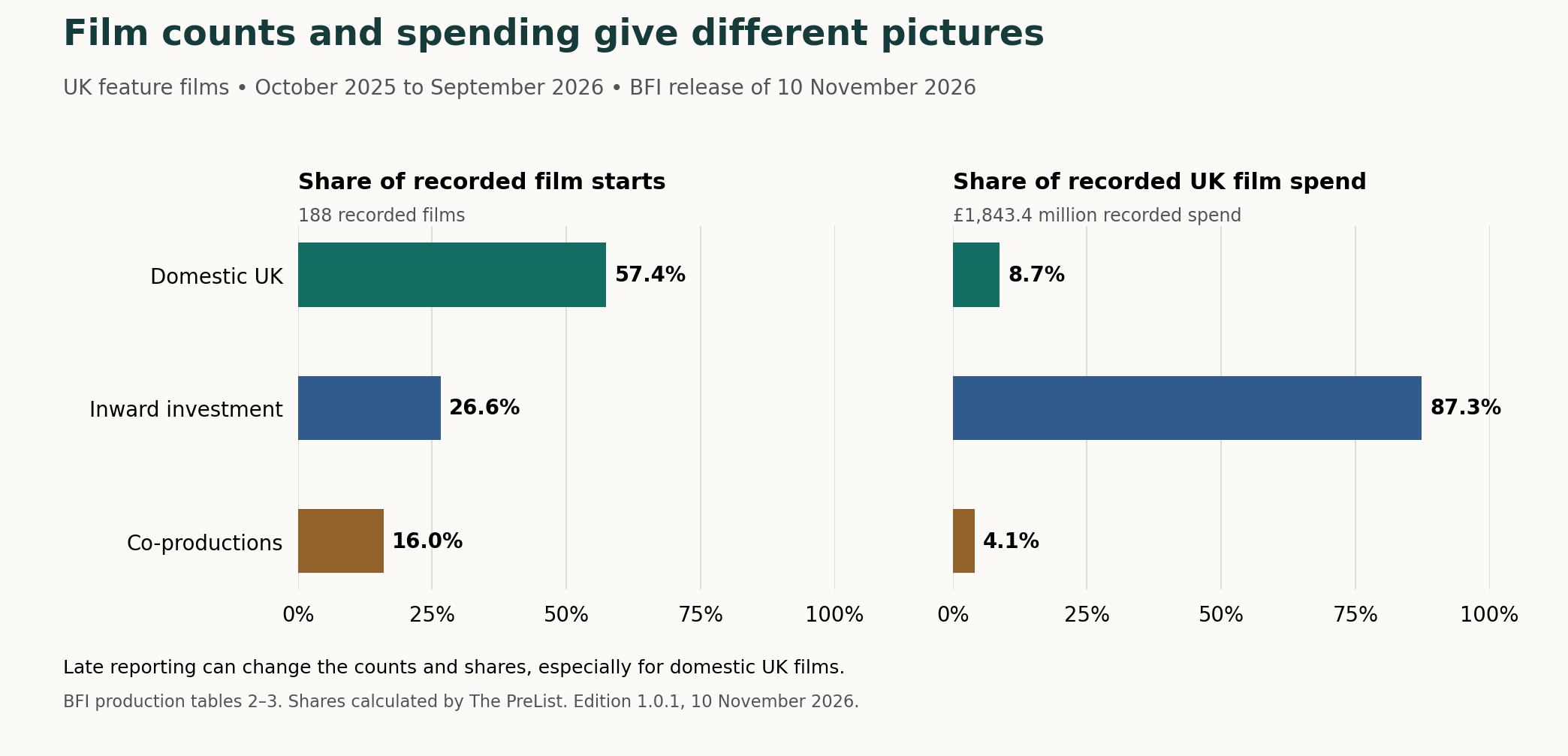
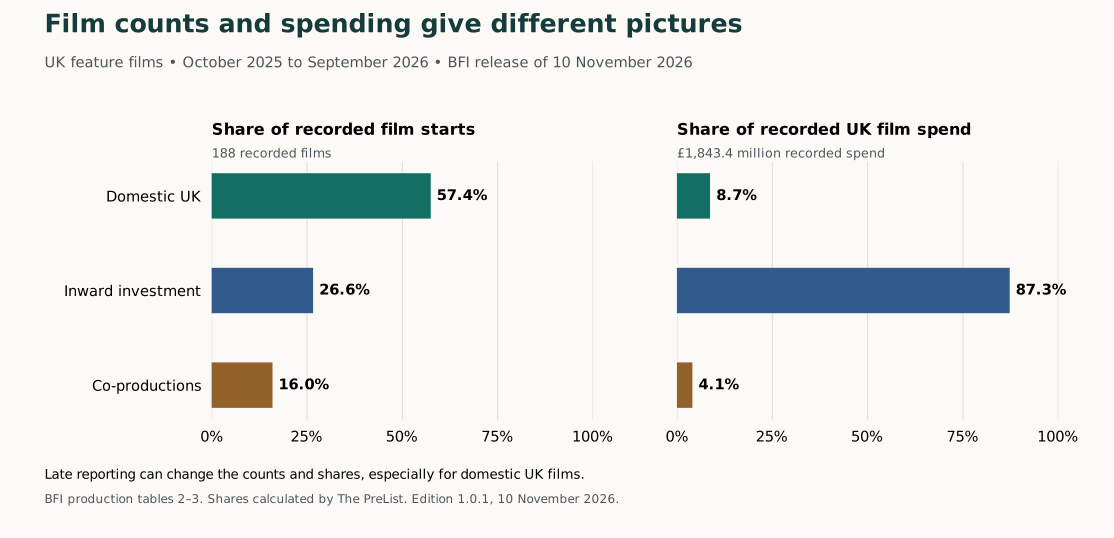
In the year to September 2026, the BFI recorded 188 feature films starting production, with £1,843.4 million in UK spend. Inward investment accounted for 87.3% of the spending across 50 films. Domestic UK productions accounted for 57.4% of the starts across 108 films. For a writer researching producers, the sector attracting the most money and the sector making the most titles give different leads. [1, Tables 2–3]
Who made the films?
The BFI counts a domestic UK film when a UK production company makes it wholly or partly in the UK. Co-productions involve UK and overseas partners. Inward investment describes productions substantially financed and controlled from abroad. These categories describe how a project is made. They tell us little about who wrote it or how a producer found the screenplay. [1, p. 10]
UK feature-film production, October 2025 to September 2026
Inward investment
- Recorded film starts
- 50
- Share of starts
- 26.6%
- UK spend (£ million)
- 1,608.5
- Share of spend
- 87.3%
Domestic UK
- Recorded film starts
- 108
- Share of starts
- 57.4%
- UK spend (£ million)
- 160.1
- Share of spend
- 8.7%
Co-productions
- Recorded film starts
- 30
- Share of starts
- 16.0%
- UK spend (£ million)
- 74.8
- Share of spend
- 4.1%
Total
- Recorded film starts
- 188
- Share of starts
- 100%
- UK spend (£ million)
- 1,843.4
- Share of spend
- 100%
The table covers 1 October 2025 to 30 September 2026. Spend is in pounds as reported. The PreList calculated each share against the BFI total. The three spending shares round to 100.1%. These are the BFI’s first figures for this period. [1, Tables 2–3]
Share of recorded film starts and UK spend
UK feature-film production, October 2025 to September 2026
188 films · £1,843.4 million UK spend
Inward investment
- Starts
- 26.6%
- Spend
- 87.3%
Domestic UK
- Starts
- 57.4%
- Spend
- 8.7%
Co-productions
- Starts
- 16.0%
- Spend
- 4.1%
What changed in the new reporting period?
Over the rolling year, recorded UK feature-film spend fell from a revised £2,768.9 million in the year to September 2025 to £1,843.4 million in the year to September 2026. That is a fall of £925.5 million, or 33.4%. Spend fell in each of the three production categories. The earlier year has had an extra twelve months for records to come in. [1, Table 2]
Across January to September alone, the BFI compares what it knew at the first release for each year. It recorded 123 starts and £1,277.6 million in 2026, against 120 starts and £2,028.8 million in 2025. That is three more recorded starts and 37.0% less spend. The largest cash difference was in inward investment, where spend went from £1,852.5 million to £1,106.9 million. [1, Table 1] [2, Table 1]
The nine-month figures answer a different question from the rolling-year figures. Each film’s UK spend is assigned to the period when principal photography starts, even if the spending takes place over a longer time. The series includes inward-investment films whose only UK work was visual effects. [1, pp. 2, 10]
What did the BFI revise?
For the same year ending September 2025, BFI’s first release recorded 167 films and £2,335.2 million. A year later those figures stood at 299 films and £2,768.9 million. Later records added 132 films to the count, including 101 domestic UK features. The spending estimate rose by £433.7 million. The BFI says reporting delays particularly affect smaller domestic films. That is why the comparison between 188 newly reported starts and 299 revised starts cannot tell us the size of a fall in production. [1, Tables 2–3 and Appendix A] [2, Tables 2–3]
The August release covered years ending in June and the first six months of 2026. November’s tables give neither those exact periods nor the quarterly figures needed to reconstruct them. Revisions to the 24 June-period figures we checked remain unverifiable. Subtracting August’s first-half figures from November’s nine-month figures would mix new starts with possible revisions to the first half. The data package preserves the August values and leaves their November comparisons blank. [1] [3]
Which feature-length productions sit outside the film figures?
In the year to September 2026 the BFI recorded a further 13 feature-length single-episode productions with £237.0 million of UK spend in high-end television. For an eligible feature-length project financed by a broadcaster or streamer, the production company can apply to the BFI for film or high-end television certification. The 188 films in the table use the BFI’s film classification throughout. This matters when a writer is looking for companies making feature-length work for streaming. [1, Tables 4–5]
How are qualifying films financed?
HMRC estimates £702 million of film relief across 1,145 claims for company accounting periods ending in financial year 2024–25. Within that total, the independent-film credit accounted for £57 million across 145 claims. The September 2026 statistics include claims received through 3 August 2026 and HMRC’s estimate for late claims. HMRC rounds amounts to £1 million and claim counts to five. [4]
One production can generate more than one claim. HMRC uses tax records and BFI certification information, and its independent-film credit has its own eligibility rules. Adding tax relief to BFI production spend, or using claims to estimate the number of scripts bought, would double-count or mix different measures. [4]
What do workers and financiers report?
Bectu surveyed screen workers from 28 February to 21 March 2025. Of 3,453 screen-industry respondents, 43% reported being out of work at the time. Bectu also reported that 70% were struggling financially, without publishing a separate response count for that question. The voluntary survey covered film, TV drama, unscripted television and commercials. It describes the respondents’ experience in early 2025. It cannot establish a current UK feature-writer unemployment rate. [5, printed pp. 11, 38–39]
At Film London’s October 2026 Production Finance Market, the organiser reported 105 producers and filmmakers and 65 financiers attending from around the world. According to its account of the keynote, Bankside Films co-founder Stephen Kelliher said his company takes on around 10–12 films a year and receives thousands of submissions. A single sales company’s experience illustrates how projects compete for a sales agent. It gives no market-wide acceptance rate. [6]
How can a writer use this?
If you are researching where to take a feature, start with credits on films comparable to yours. Identify the production company, its financing partners and the sales company. Check the producer’s current submission policy separately. The domestic count can help you decide where to look. Only company-level evidence can tell you whether a particular producer works at your scale or accepts approaches.
For questions about working terms, the University of York’s July 2025 report offers a closer view. Its 23 interview participants included film and television writers and industry representatives. Researchers used purposive and referral recruitment, and the sampled writers were WGGB-affiliated. The interviews concern experiences before the 2024 WGGB–Netflix agreement. They shed light on streaming contracts while leaving open the question of what UK feature writers typically earn now. [8, pp. 12–14, 44]
None of the sources reviewed establishes a recent representative figure for feature-writer employment, earnings or spec sales. The WGGB’s 2022 snapshot poll and its 2025 call for evidence on unpaid work also leave that question open. [7]
Sources, method and maintenance
Evidence scope and limitations
BFI production tracking
- Period or observation
- Year to September 2026 and January–September first reports
- What it measures
- Recorded feature starts, UK spend and production mix
- Limit
- Late records, especially for smaller domestic films
HMRC tax statistics
- Period or observation
- Financial year 2024–25
- What it measures
- Relief and claims for qualifying productions
- Limit
- One film can generate claims in several accounting periods
Bectu voluntary survey
- Period or observation
- 28 February to 21 March 2025
- What it measures
- Screen workers’ employment and financial experience
- Limit
- A self-selected group spanning several screen sectors
Film London event account
- Period or observation
- October 2026
- What it measures
- Event attendance and one sales company’s experience
- Limit
- An international event and a single company
University of York interviews
- Period or observation
- Published July 2025, concerning experiences before the 2024 agreement
- What it measures
- Film and television writers’ contractual experiences
- Limit
- A qualitative group recruited for its experience
The PreList used published primary evidence from five organisations and reviewed WGGB material for the question about earnings. Production figures, tax claims, survey responses, interviews and event attendance retain their own dates and populations. The share calculations use BFI’s published totals. No adjustment for inflation or estimate of missing films has been applied.
1. British Film Institute, Research and Statistics Unit. Film and high-end television production, January to September 2026 and year ending September 2026, 10 November 2026. Tables 1–5, Appendix A and definitions. Report (PDF) · Underlying tables (ODS).
2. British Film Institute, Research and Statistics Unit. First report for the equivalent September 2025 periods, 6 November 2025. Tables 1–3. Report (PDF) · Underlying tables (XLS).
3. British Film Institute, Research and Statistics Unit. Production release for January to June 2026 and year ending June 2026, 11 August 2026. Report (PDF) · Underlying tables (ODS) · Official statistics release calendar.
4. HM Revenue & Customs. Creative industries statistics, 17 September 2026. Film section and Tables 1–2 of the commentary, cross-checked with spreadsheet Table 1.1. Commentary · Underlying tables (ODS).
5. Bectu. The September 2025 report and June screen briefing draw on the same survey. Printed pages 11 and 38–39 of the full report correspond to PDF pages 13 and 40–41. Full report (PDF) · Screen briefing (PDF).
6. Film London. Organiser’s report on the Production Finance Market, 7 October 2026. Event and keynote account.
7. Writers’ Guild of Great Britain. Historical poll and call for evidence reviewed for context. Film-screenwriter poll, 11 October 2022 · Unpaid work evidence call, 20 May 2025.
8. Hunter, C., Sun, H., MacKillop, R. and van der Borgh, S., University of York. Screenwriters’ Earnings in the Video Streaming Age, July 2025, pp. 12–14 and 44. Report and DOI · University publication record.
Correction, 10 November 2026. The production company applies to the BFI for certification. Broadcasters and streamers may finance the project. The WGGB’s 2022 poll gives no fieldwork dates. Its 2025 invitation asks about the preceding 12 months and reports no results. All production figures and findings stand. Previous edition 1.0.
This edition preserves the evidence available on 10 November 2026. We review subsequent BFI production releases for material changes.
Suggested citation. The PreList (2026). The UK feature-film production picture. Edition 1.0.1, 10 November 2026. Permanent edition.
Article, data and reproduction files
Download the evidence for edition 1.0.1, including the original calculations and a record of which earlier figures the BFI revised.
- Article (Markdown)
- Complete edition and reproduction files (ZIP)
- Production counts, spend and shares (CSV)
- January to September first reports (CSV)
- Revisions to the same September periods (CSV)
- June figures reviewed for revisions (CSV)
- Source details and original-file hashes (JSON)
- Edition record (JSON)
The PreList’s commentary and chart design are available under CC BY 4.0. Third-party material retains its own terms.